
TigriSat launched on 19 June 2014 aboard a Dnepr rocket from Yasny in southern Russia, deploying from the Italian UniSat-6 carrier satellite into a sun-synchronous orbit at roughly 640 km altitude. It is a 3U CubeSat built by Iraqi students at La Sapienza University of Rome, funded by the Iraqi Ministry of Science and Technology, with a mission to detect dust storms over Iraq using an onboard RGB camera.
It is also, officially, Iraq's first satellite. In 1989, under Saddam Hussein's government, Iraq claimed to have launched a satellite. Still, footage of the launch showed the vehicle exploding early in the ascent, and it is widely considered to have never reached orbit. TigriSat settled the question. A satellite built by Iraqi engineers and students, studied at a university in Rome, launched on a repurposed Soviet ICBM, and operated jointly between Italy and Baghdad: it is one of the more unlikely origin stories in the CubeSat era, and a good one.
We received TigriSat beacons at the Remos Melderstein ground station in Sweden using the Expedite modem. This post documents the pass planning, configuration, and what the decoded frames look like.
The link: AX.25 over G3RUH at 9600 baud
TigriSat uses a GomSpace radio running what GomSpace calls mode 6: AX.25 framing over a 9600 baud G3RUH physical layer at 435 MHz. Both are well-established amateur satellite standards with a long history.
AX.25 is the link-layer protocol that has been the backbone of amateur packet radio since the 1980s. It defines a frame with source and destination callsign fields, a control byte, and a PID byte that signals what is carried in the payload. TigriSat transmits with source callsign HNATIG and destination CQ, the standard AX.25 broadcast address, meaning the beacon is addressed to anyone listening. The HN prefix is Iraq's ITU-assigned amateur radio country code.
G3RUH is the 9600 baud physical layer designed by James Miller (G3RUH). It uses direct FSK modulation with NRZ-S line coding and a multiplicative scrambler with polynomial h(x) = 1 + x¹² + x¹⁷ to ensure bit transition density regardless of data content. We covered the G3RUH scrambler and how it differs from the additive CCSDS scramblers in our article on synchronization in burst-mode satellite communication.
TigriSat is technically a burst-mode transmitter, but in practice it operates in what is best described as quasi-continuous mode. Each beacon frame is preceded by a very long preamble, long enough that the receiver's carrier and timing loops have well over enough time to fully acquire before any data arrives. From the receiver's perspective this is indistinguishable from a continuous link: by the time the payload reaches the demodulator, all loops are locked and tracking. This is why Burst Mode is left off on the Expedite receiver for this link. Enabling it would widen the timing loop bandwidth unnecessarily, since the long preamble removes the tight acquisition time constraint that Burst Mode is designed to handle.
Pass planning
Expedite includes a built-in pass scheduler that ingests TLE data and computes upcoming passes for any number of satellites simultaneously. The scheduler runs in the background and cues the receiver automatically at the predicted acquisition start of each pass. At the Melderstein station we had four TigriSat passes scheduled on 14 July 2026, visible in the timeline alongside other satellites being tracked on the same day.
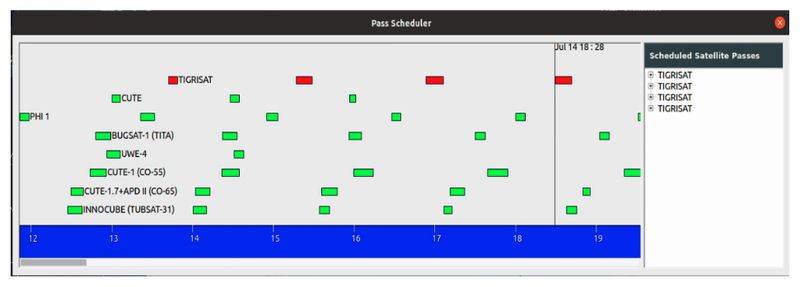
Expedite pass scheduler showing TigriSat (red, flagged as received) and co-scheduled satellites across the day. The right panel lists the four upcoming TigriSat passes queued for automatic acquisition.
TigriSat is shown in red in the scheduler, which flags satellites for which recent reception data is available. The other satellites in the timeline (CUTE, PHI 1, BUGSAT-1 (TITA), UWE-4, CUTE-1, CUTE-1.7+APD II, and INNOCUBE) were being tracked simultaneously on separate channels, illustrating how the Expedite scheduler manages a multi-satellite observation plan across a full operational day.
The skyplot below shows the predicted ground track for one of the TigriSat passes as seen from Melderstein. The pass rises from the south, swings northward, and crosses the northern sky, a typical geometry for a sun-synchronous orbit viewed from Sweden's latitude.
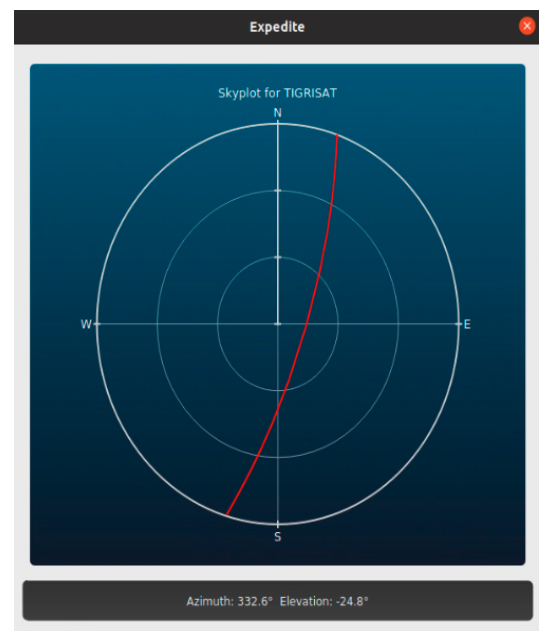
Expedite skyplot for TigriSat as seen from the Melderstein ground station. The red track shows the satellite rising from south-southwest and transiting northward. Azimuth 332.6°, elevation -24.8° at the time of capture (satellite approaching from below the horizon).
Expedite receiver configuration
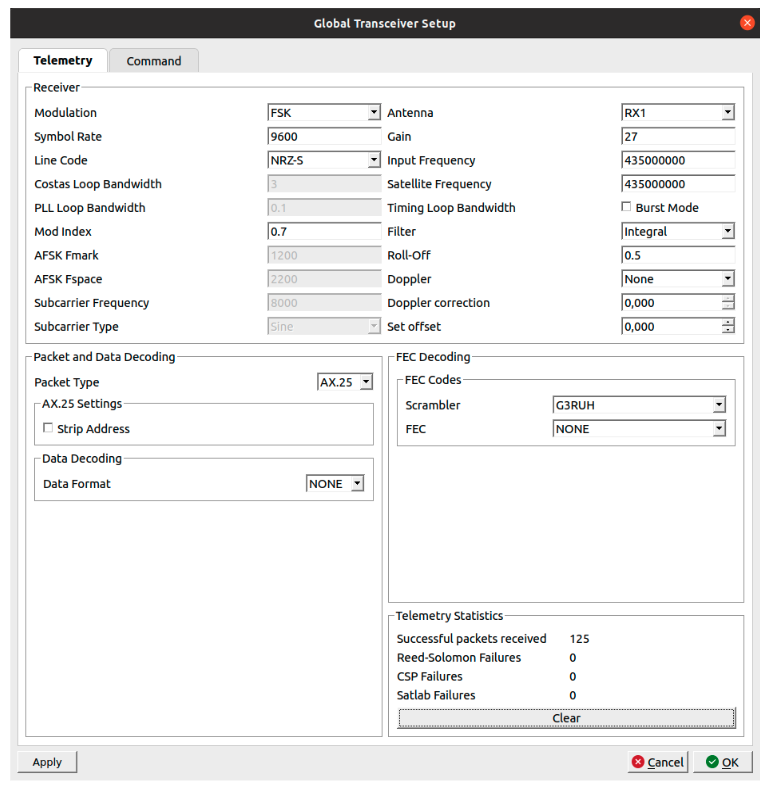
Expedite receiver configuration for TigriSat: FSK at 9600 baud, NRZ-S line code, 435 MHz, G3RUH scrambler, AX.25 packet type. 125 packets received with zero failures
The configuration is straightforward. Modulation is set to FSK with a symbol rate of 9600, line code NRZ-S, and input frequency 435.000 MHz. The filter is set to Integral with a roll-off of 0.5 and mod index 0.7, matching the G3RUH spectral shaping. In the FEC Codes section, Scrambler is set to G3RUH and FEC to None; G3RUH does not use a block code on the downlink, relying on the scrambler alone for transition density. Packet Type is AX.25.
The result across the pass: 125 packets received successfully, zero Reed-Solomon failures, zero CSP failures, zero Satlab failures.
The received frames
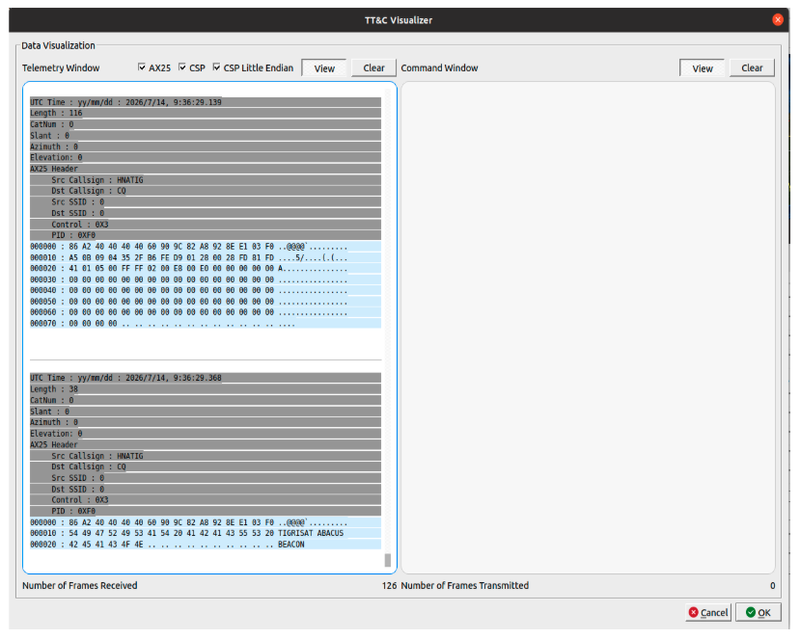
Expedite TT&C Visualizer showing decoded TigriSat AX.25 frames received at Melderstein: source callsign HNATIG, destination CQ, with the TIGRISAT ABACUS BEACON identification string visible in the second frame. 126 frames received total.
The TT&C Visualizer shows two frame types arriving during the pass. Both carry the same AX.25 header: source callsign HNATIG, destination CQ, Control 0x03 (UI frame, unnumbered information), PID 0xF0 (no layer 3 protocol).
The first is a longer housekeeping frame at 116 bytes. The payload carries structured telemetry: battery voltage, temperature readings, and subsystem status. These are the frames that let the operations teams in Rome and Baghdad monitor the satellite's health on every pass.
The second is a short 38-byte identification beacon. The payload is human-readable: TIGRISAT ABACUS BEACON. This is TigriSat's broadcast identification string, transmitted so that any station receiving the signal knows immediately which satellite it is hearing. Seeing it decoded cleanly at Melderstein confirms that the full chain (G3RUH descrambling, AX.25 framing, and payload extraction) is working end to end.
AX.25 Header
Src Callsign : HNATIG (HN = Iraq amateur radio prefix)
Dst Callsign : CQ (broadcast address)
Control : 0x03 (UI frame, unnumbered information)
PID : 0xF0 (no layer 3)
Payload (38-byte beacon frame):
54 49 47 52 49 53 41 54 20 41 42 41 43 55 53 20 TIGRISAT ABACUS
42 45 41 43 4F 4E BEACON
Why this is worth noting
The GomSpace radio stack, AX.25 over G3RUH at 9600 baud, is one of the most widely deployed link configurations in the CubeSat community. It appears on dozens of satellites currently in orbit across university, national, and commercial missions. Being able to receive it with Expedite at Melderstein, with a straightforward configuration and the pass scheduler handling acquisition automatically, means that any operator flying a GomSpace-equipped spacecraft can use Expedite as their ground-side modem without additional hardware or custom software.
TigriSat is a good test case because it is a real mission with a real history, still transmitting more than a decade after launch. If the link works for TigriSat, it works for the category of satellites it represents.
The satellite was built by students who had to cross borders, navigate funding from a Ministry in Baghdad, and borrow infrastructure from a university in Rome to put Iraq in orbit for the first time. It has been transmitting from 640 km for over ten years. Receiving its beacon from Melderstein is, in a small way, participating in that.
References
9600 Baud Packet Radio Modem — James Miller G3RUH
Synchronization in Burst and Continuous Satellite Communication — Remos Space Systems