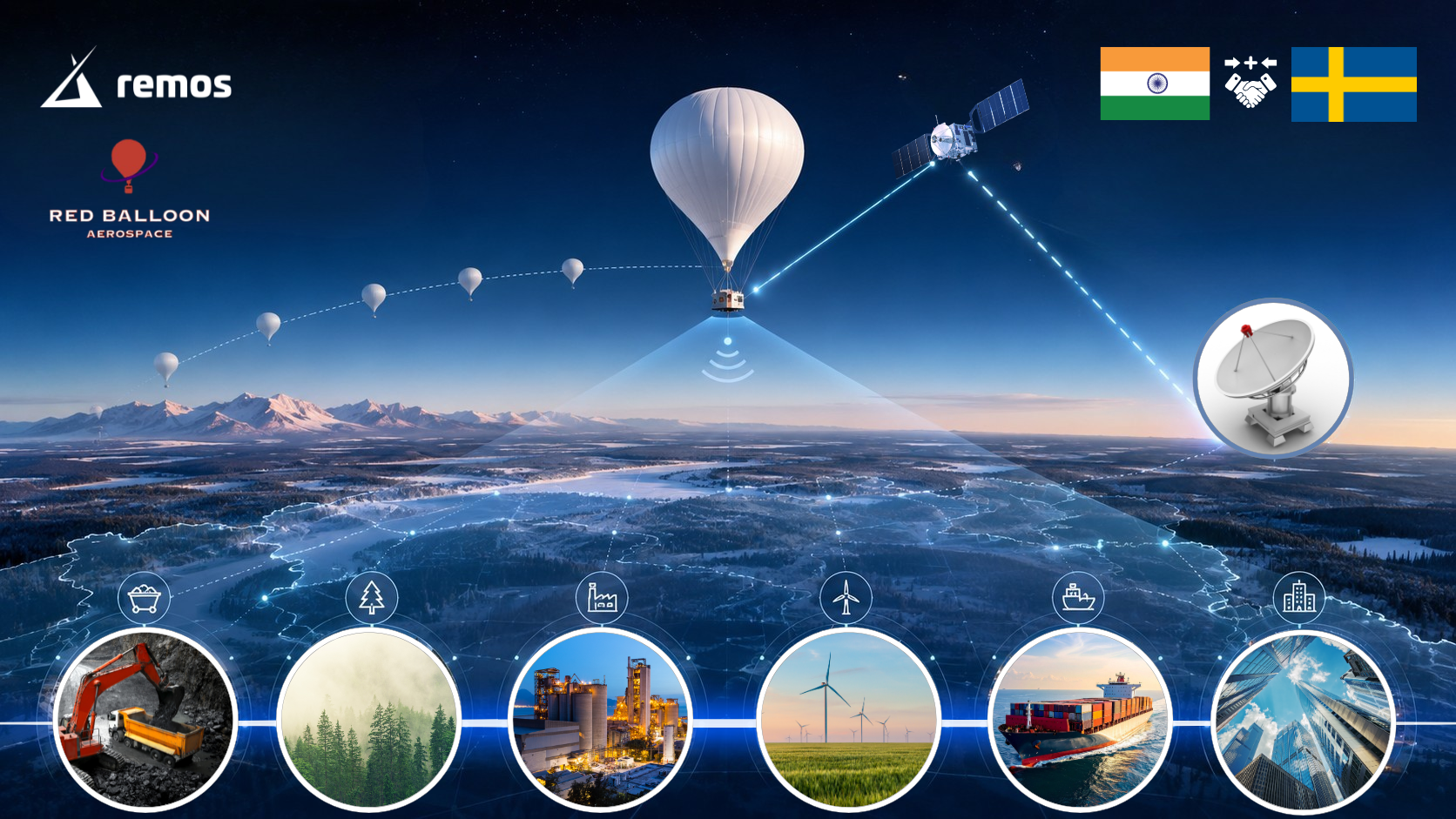
Remos Space Systems, in collaboration with Red Balloon Aerospace, has been selected under the prestigious “Collaboration with India, Company-Driven Research and Innovation Projects 2025” initiative supported by Vinnova, Sweden’s Innovation Agency.
The awarded project, titled “AI-Driven Remote Emission Monitoring Platform for Steel & Cement,” represents an important step toward leveraging advanced aerospace and AI technologies for industrial sustainability and environmental intelligence.
At its core, this project is about using advanced technology to solve a very real industrial challenge: how we monitor emissions more intelligently, accurately, and at scale.
Industries like steel and cement are essential to global infrastructure and economic growth, but they are also among the largest contributors to industrial emissions worldwide. Traditional monitoring systems often struggle with scalability, real-time visibility, and cost efficiency. That’s where this collaboration comes in.
What makes this project particularly unique is its approach. Instead of relying on satellites, the platform will leverage high-altitude balloon technology to carry advanced sensing capabilities closer to the area of interest. Developed by Red Balloon Aerospace, these balloons feature sophisticated station-keeping capabilities that could enable operations spanning several months, offering persistent and cost-effective monitoring over industrial sites.
To fully unlock the potential of these extended-duration near-space missions, reliable communications and mission connectivity are essential.
Remos Space Systems will support the initiative with its advanced communication systems, providing the technologies required for secure data transmission, continuous connectivity, and efficient mission operations for long-endurance high-altitude balloon deployments.
By combining AI, remote sensing technologies, and high-altitude balloon platforms, the project aims to build a smarter system to monitor industrial emissions more effectively and remotely. The vision is simple: give industries better tools to understand their environmental footprint and make faster, more informed decisions.
Reflecting on what this recognition means for the company, Dr. Moses Brown Emwakyanjala and Petter Lindberg, Co-Founders of Remos Space Systems, said:
“For us at Remos Space Systems, this recognition means a lot more than just winning a project. It reflects the growing role of advanced communications and aerospace technologies in solving challenges far beyond the traditional space sector. At Remos, we believe that robust and resilient communication systems are fundamental to any remote sensing mission, whether in space or in the emerging near-space domain.”
What makes this initiative especially meaningful is the international collaboration behind it. India and Sweden have been steadily strengthening ties in innovation, sustainability, and deep-tech development. Programs like this create an environment where companies from both countries can come together, combine strengths, and build solutions with global impact.
We’re also proud to be collaborating with Red Balloon Aerospace on this initiative. Partnerships like these are where some of the best innovation happens, when different perspectives, technical capabilities, and ambitious ideas come together around a common mission.
Dr. C.V.S. Kiran, Co-Founder & CEO of Red Balloon Aerospace, emphasized the significance of the partnership:
"This partnership demonstrates how near-space technologies can address some of the world's most pressing industrial sustainability challenges. By integrating Red Balloon Aerospace's persistent high-altitude platforms with Remos Space's advanced software-defined ground systems, we are creating a solution capable of continuously monitoring fugitive greenhouse gas emissions with unprecedented coverage and cost efficiency. Together, we aim to provide industries with actionable environmental intelligence that accelerates the transition to low-carbon manufacturing."
Sireesh P., Co-Founder & COO of Red Balloon Aerospace, highlighted the broader strategic importance of the collaboration:
"The India-Sweden collaboration is a powerful example of how two innovation-driven ecosystems can jointly develop technologies with global impact. Through this partnership, we are combining engineering excellence, climate innovation, and commercial scalability to deliver an affordable emissions monitoring solution for steel and cement industries. Beyond supporting industrial decarbonization, this initiative lays the foundation for exporting Indian-developed near-space technologies to international markets while strengthening long-term technology collaboration between India and Sweden."
The future of industrial sustainability will rely heavily on intelligent monitoring systems, predictive analytics, and scalable environmental intelligence. AI-driven platforms are no longer “future concepts”; they are quickly becoming operational necessities for industries worldwide. Innovations such as long-endurance high-altitude balloon platforms open up entirely new possibilities for persistent environmental monitoring and industrial intelligence.
And that’s exactly why this project matters.
At Remos Space Systems, we believe the future of aerospace innovation is deeply connected with solving challenges here on Earth, whether that’s through smarter infrastructure, climate resilience, industrial intelligence, or sustainable technologies.
We’re grateful to Vinnova and all stakeholders involved for believing in this vision and supporting cross-border innovation initiatives like this one.
This is just the beginning, and we’re excited for what comes next.